Modern Etiquette Micro-Course: Texting, RSVPs & Social Media

Modern Etiquette Micro‑Course: Simple Guidelines for Texts, Social Media, RSVPs, and Everyday Politeness
Modern manners live in the small moments: a quick reply, a thoughtful RSVP, a considerate comment, or knowing when to put the phone away. This micro‑course and printable digital guide offers practical, up-to-date rules of thumb for daily interactions—especially the ones that happen on screens—so conversations stay clear, kind, and drama-free.
What “modern etiquette” actually solves
Etiquette isn’t about being formal; it’s about removing friction. Good “modern etiquette” makes everyday communication easier in a world where tone is hard to read and attention is always split.
- Reduces misunderstandings caused by short messages, tone ambiguity, and delayed replies.
- Sets clear boundaries around availability, group chats, and after-hours communication.
- Helps keep relationships intact during stressful moments: cancellations, late RSVPs, sensitive topics, and public posts.
- Builds credibility and warmth at work and in community spaces without sounding stiff or outdated.
- Replaces guesswork with quick scripts and decision rules that work across cultures and contexts.
For deeper background on long-standing etiquette principles that still apply today, the Emily Post Institute is a helpful reference point—modern etiquette just adds faster pacing and more digital nuance.
Texting etiquette that keeps conversations easy
Texting is convenient, but it’s also a high-speed way to misread each other. A few lightweight habits keep things smooth without turning every message into a formal letter.
- Reply timing: aim for “same day” for most personal texts; for time-sensitive plans, reply as soon as seen.
- Tone clarity: use complete sentences when the topic is serious; avoid sarcasm in high-stakes messages.
- Double-texting: acceptable when adding missing context (address, time, correction) or after a reasonable pause.
- Read receipts and typing indicators: treat them as optional signals, not obligations; avoid calling someone out for leaving a message on read.
- Group chat manners: keep announcements short, avoid side conversations, and respect quiet hours.
- Voice notes and calls: ask before sending long voice messages; call when nuance matters or conflict is brewing.
- Boundaries: use polite “response windows” (e.g., “I’m offline after 8, will reply tomorrow”) instead of disappearing.
Quick texting choices
| Situation | Best move | Why it works |
|---|---|---|
| Late reply | Acknowledge + answer (no long apology) | Keeps momentum without making it awkward |
| Misread tone | Clarify intent plainly | Prevents escalation and saves face |
| Need a favor | Ask with a clear out | Respects time and reduces pressure |
| Sensitive topic | Suggest a call or in-person chat | Cuts down on misinterpretation |
If online life is starting to feel emotionally “loud,” it can also help to reset habits around how and when you engage. The American Psychological Association’s tips for healthy social media use align well with etiquette basics: more intention, fewer reactive replies.
Social media etiquette: post with care, comment with restraint
Social platforms mix audiences (friends, coworkers, family, strangers), which is why the same post can land beautifully for one person and painfully for another. A simple check before you hit “share” prevents a lot of fallout.
- Before posting: consider whether it’s kind, true, necessary, and appropriate for a mixed audience.
- Tagging and sharing: ask permission before tagging someone in unflattering photos or sharing private milestones.
- Commenting: avoid correcting people publicly; move disagreements to private messages or opt out.
- Privacy basics: check visibility settings regularly; assume screenshots are possible even in “private” spaces.
- Work and personal crossover: keep public profiles neutral on divisive topics if professional relationships are impacted.
- Friend requests and follows: don’t take declines personally; treat social connections as optional, not mandatory.
- Graceful exits: unfollow/mute is often kinder than public announcements or passive-aggressive posts.
It’s also worth remembering how common social media use is and how varied norms can be across age groups and communities; the Pew Research Center social media fact sheet offers helpful context.
RSVP etiquette: the simplest way to be a great guest
RSVPs aren’t “extra”—they’re the planning tool that keeps events enjoyable and affordable. A fast, clear answer is one of the most considerate things you can do.
Everyday politeness that still matters (even on busy days)
What’s inside the printable micro‑course (and how to use it)
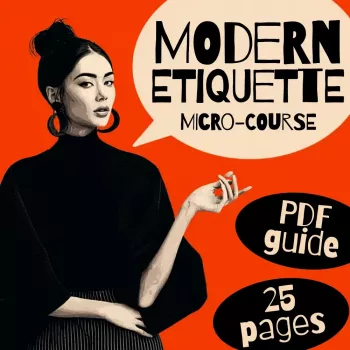
Start here: Modern Etiquette Micro‑Course printable digital guide.
If you’re pairing etiquette with personal growth routines, these two complements also fit well into a “weekly reset” mindset:
Time-saving outfit combinations for effortless style and
Creative writing exercises eBook.
A quick reset routine for tricky moments
FAQ
How fast should someone respond to a text?
For time-sensitive plans, respond as soon as you see the message; for most personal texts, same day is a solid norm. If you’re delayed, a simple boundary like “In meetings today—will reply tonight” keeps things clear without over-apologizing.
Is it rude to leave a group chat on read?
Not necessarily—silence can be neutral when no decision is needed. If the chat is coordinating plans, a quick reaction or short “Got it” helps; otherwise, muting the thread and setting expectations during busy periods is often the most polite move.
What is the most polite way to decline an invitation after saying “maybe”?
Send a brief note as soon as you know: appreciation + clear no + optional short reason + goodwill. Example: “Thanks so much for inviting me—turns out I can’t make it. Hope it’s a great night, and I’d love to catch up soon.”














Leave a comment