Modern Calligraphy Alphabet Practice: Drills & Routines
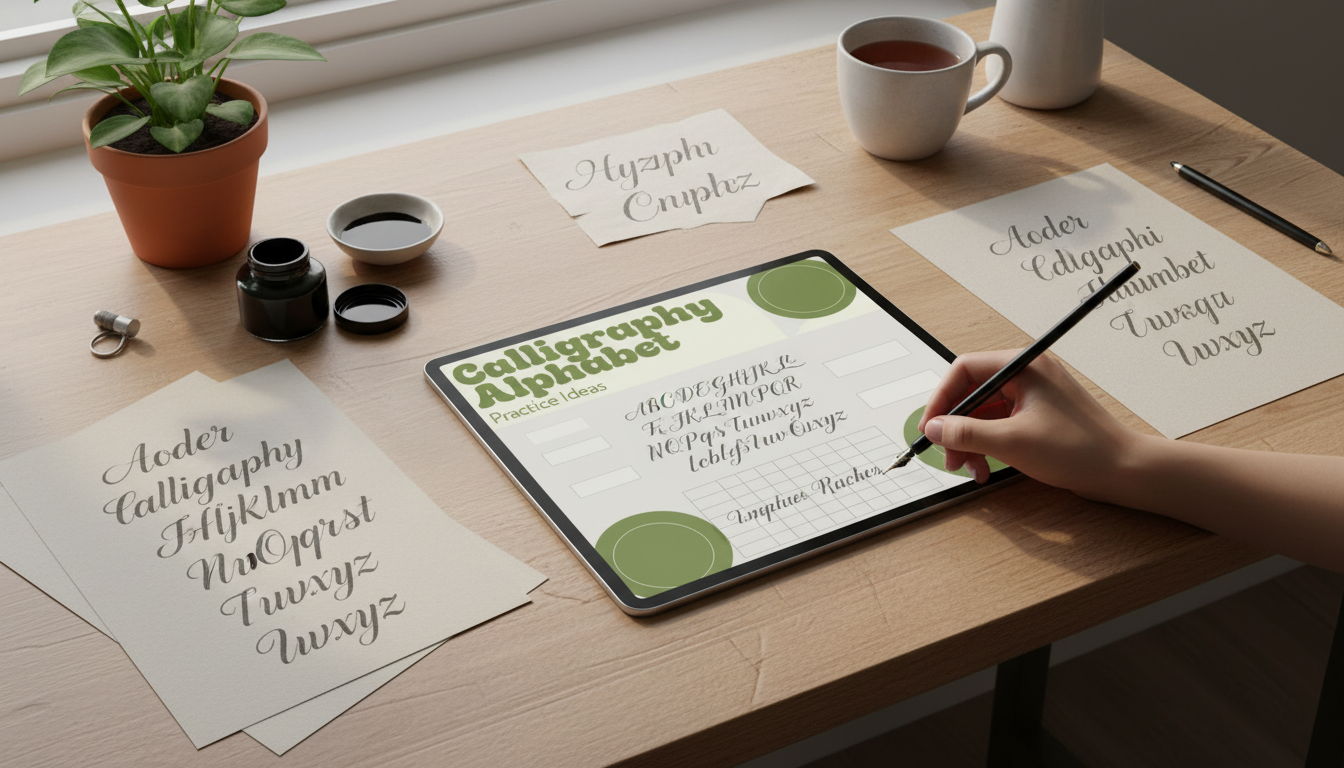
Calligraphy Alphabet Practice Ideas for Modern Lettering: Drills, Variations, and Skill-Building Routines
Building a confident calligraphy alphabet comes from small, repeatable drills that train consistency before speed. A smart practice routine focuses on a few core strokes, then uses them to refine letter shapes, spacing, slant, and rhythm. The ideas below turn alphabet practice into structured, creative sessions—so letters look intentional on envelopes, cards, journals, and digital designs without feeling like endless repetition. For more guidance, see Free PDF Worksheets to Practice Brush Lettering – Domestika.
Set up a practice session that actually improves your letters
A productive session has a single target, a short warm-up, and a simple way to “grade” progress. This keeps practice from turning into mindless pages of A–Z. For further reading, see FREE HAND LETTERING WORKSHEETS FOR BEGINNERS.
- Choose one style goal per session: slant consistency, lighter upstrokes, smoother ovals, or tighter spacing.
- Warm up for 2–3 minutes with basic strokes: thin upstroke, thick downstroke, overturn, underturn, oval, compound curve.
- Use guide lines (baseline, waistline, ascender/descender lines) and add a slant guide if your style needs it.
- Limit your alphabet focus: practice 6–8 letters that share shapes instead of all 26 at once.
- Track one measurable check: spacing between letters, height consistency, or stroke contrast.
15-minute modern calligraphy practice flow
| Time | Focus | What to do | Success check |
|---|---|---|---|
| 2 min | Warm-up strokes | Upstroke rows, downstroke rows, ovals | Even pressure changes, clean entry/exit |
| 5 min | Family letters | Pick one family (e.g., i/u/w/t) and write slow, large | Consistent slant and spacing |
| 5 min | Trouble letters | Isolate 2 letters and repeat only the hardest joins | Joins look intentional, no wobble |
| 3 min | Application | Write 3–5 words using today’s letters | Legibility improves without losing style |
If you like having everything laid out in one place, the Calligraphy Alphabet Practice Ideas – Digital Download Guide for Modern Calligraphy, Lettering Practice, Alphabet Drills & Creative Skill Building is an easy way to keep drills, variations, and weekly routines organized.
Practice letters by “families” instead of A–Z
Letter “families” share the same building blocks. When you practice by family, improvements show up faster because the same movement repeats across multiple letters.
- i/u/w/t family: train underturn/overturn rhythm, consistent stems, and dot/cross placement.
- n/m/h/r family: focus on shoulder height, spacing inside humps, and smooth transitions.
- o/a/d/g/q family: perfect ovals, counter space, and clean looped exits.
- c/e family: refine open counters and consistent entry strokes.
- l/b/k/f family: practice tall ascenders, loop control, and balanced negative space.
- s family: break into parts (top curve, center transition, bottom curve) and practice each segment.
For extra structure, keep a “family of the week” list. On Monday–Wednesday, drill the family slowly. On Thursday, add joins. On Friday, write short words that force repeat connections (like “minimum” for the i/n/m rhythm).
Alphabet drills that build muscle memory (without boredom)
Drills work best when they train a single skill at a time. Rotate these so practice stays focused and fresh.
- Stroke ladders: write the same stroke bigger → smaller to control pressure at different sizes.
- Slow-to-fast reps: 3 slow perfect letters, then 3 slightly faster—keep form, not speed, as the priority.
- One-parameter drill: keep everything identical except one variable (slant, spacing, bounce height, or flourishes).
- Mirror drill: write a letter, then attempt a mirror version to reveal inconsistencies in curves and pressure.
- Join-only drill: write only the connecting strokes between letters (e.g., “in in in”, “oo oo oo”) to smooth transitions.
When you want a deeper dive into letterform traditions (and plenty of exemplars), explore resources from IAMPETH. For approachable modern practice ideas and printable guides, The Postman’s Knock is a strong reference.
Make alphabet practice creative: variations that still teach fundamentals
Creativity is more useful after the base structure is stable. These variations keep fundamentals in charge while letting style come through.
- Bounce lettering: assign three bounce levels (none, small, medium) and apply them consistently to one word.
- Style swaps: write the same alphabet in two versions—monoline and pointed-pen contrast—to understand structure vs. shading.
- Weight experiments: keep letter shapes identical while changing pressure contrast (low, medium, high).
- Narrow vs. wide: write letters with the same height but different widths to train proportion control.
- Texture drills: add faux-calligraphy shading, watercolor fill, or stipple effects only after the base form is consistent.
To turn practice into finished pages you’ll actually keep, pair lettering sessions with prompts and short phrases. The Creative Writing Exercises eBook | Creative Writing Exercises for Writers, Storytelling Prompts, Character & Plot Development Guide can supply quick lines to letter—useful when you’ve practiced strokes and want real words without overthinking what to write.
Common sticking points and quick fixes
If letter structure feels confusing, a quick overview of what calligraphy encompasses can help with terminology and styles before you choose a direction: Wikipedia – Calligraphy.
Turn practice into finished projects to lock in progress
FAQ
How long does it take to improve a calligraphy alphabet?
Noticeable improvement often shows up in 2–6 weeks with short, consistent sessions (10–20 minutes) rather than occasional long practice. Track one metric—like slant consistency or spacing—so progress is measurable.
Should alphabet practice be done in lowercase before uppercase?
Lowercase is usually best first because the stroke families repeat and build steadier muscle memory. Add uppercase once baseline and waistline control feels consistent, or sooner if a specific project needs capitals.
What’s the best way to practice spacing between letters?
Focus on matching negative space rather than equal distances, and use light guide dots to mark “air gaps” if spacing keeps collapsing. Practice common joins (like “in,” “no,” and “oo”) slowly and check spacing every few letters.
















Leave a comment